
Digital screens instead of yellow and red cards! Discussions underway regarding new technology in football
97 Repoter: 97 Admin
Publish : 4 hours agoUpdate: 37 minutes ago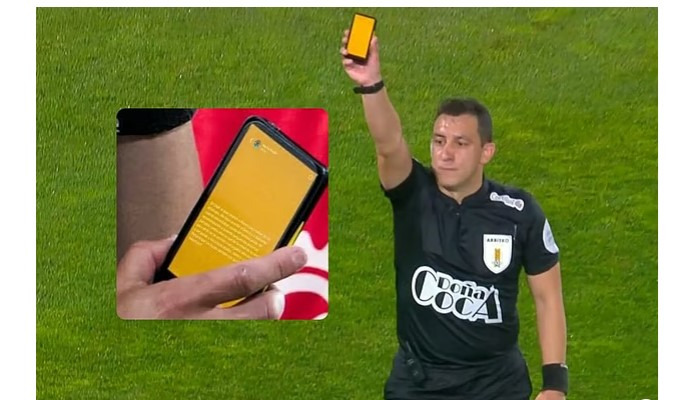
Digital screens instead of yellow and red cards! Discussions underway regarding new technology in football
Digital screens instead of yellow and red cards! Discussions underway regarding new technology in football
Is the familiar sight of yellow and red cards on a football pitch about to change? A video circulating on social media has sparked this question. In the footage, a referee is seen holding up an electronic device—resembling a mobile phone—instead of the traditional yellow card to caution a player. This incident is part of a trial for a digital card system currently being tested in Uruguayan domestic football.
During a match between Nacional and Rentistas in the Uruguayan Cup last Thursday, referee Eduardo Varela was seen using this device. The objective goes beyond merely changing how cards are shown; it aims to document various match events and streamline the referee's administrative tasks.
Why the initiative for digital cards?
The project is spearheaded by an organization called 'Refe'. In an interview with the Uruguayan radio station 'El Espectador Deportes' on Friday, the organization's director, Mauro Sacco, stated, "We are working to introduce technology into the one aspect of football that remains analog."
The concept of a digital card is not entirely new. Over three years ago, Sacco and his co-director, Diego de la Peña, conceived the idea while watching a match in the rain. They observed that after issuing a caution or a sending-off, referees had to manually record the details on paper—information that later had to be transcribed into a digital system.
The digital card initiative was developed to simplify this process.
The new device can record various match events, complete with timestamps. The creators aim to make the submission of official match reports to the Uruguayan Football Association’s 'COMET' platform faster and more efficient.
There are advantages, but the drama of showing a card is diminished.
Referee Eduardo Varela, who used the device during the trial, reported a positive experience. According to him, the device is comfortable to use, and its software operates quickly. However, the immediate drama associated with the traditional act of showing a physical card is somewhat diminished when displayed on a digital screen.
Varela notes, "The magical element of quickly flashing a card is somewhat lost, but I believe it will be a great help, especially with administrative tasks."
In essence, the primary goal of this technology—beyond communicating decisions on the pitch—is to streamline the preparation of necessary post-match documentation.
The Biggest Challenge: Visibility
The initial testing of this new technology has revealed certain limitations. A key concern is whether the device's screen is sufficiently clear. A previous pilot project had to be abandoned because the text and colors on the screen became difficult to discern under direct sunlight.
During last Thursday’s match, some spectators in the stadium, as well as those watching on television, struggled to clearly identify the decisions being displayed.
Diego de la Peña acknowledges, "This is a project with room for improvement. It was more visible inside the stadium than on television. Our current challenge is to enhance the experience for all spectators—ensuring that a yellow card truly appears yellow, a red card appears red, and that both are clearly visible to everyone, whether in the stadium or watching on TV."
To ensure the colors are more distinct for the audience, the developers are exploring various modifications, including the addition of LED lights around the device. Those involved in the project have confirmed that the brand is registered, and both the hardware and software have been patented. The developers behind the project are based in China.
Aiming for Recognition from FIFA and CONMEBOL
The digital card has elicited mixed reactions on social media. While some have expressed interest in the potential of this new technology, others have questioned its effectiveness as a replacement for traditional cards. It has even become the subject of various memes.
De la Peña remarks, "We’ve seen a range of positive and negative comments—we’ve even had a good laugh at some of the memes. The important thing is that people are talking about it." ‘Any new innovation takes some time.’
The project’s initiators hope to gain recognition from CONMEBOL—the governing body for football in South America—and FIFA, the international football governing body, once the technology has been further refined and developed.
However, it is not yet certain whether these digital cards will eventually replace the traditional yellow and red cards. For now, the primary objective is to simplify the administrative tasks of referees. If the challenges related to visibility and practical limitations can be overcome, this could become a new addition to the use of technology in football.